You don't have to love or hate the NBA's Apron Era
The NBA has had a massive paradigm shift in the past few years, and it's impacting every team in the league and most players. It's led to increased parity and hope among the miserable, and it's breaking up fun teams. All things are true.
The NBA has had a massive paradigm shift in the past few years, and it's impacting every team in the league and most players. It's led to increased parity and hope among the miserable, and it's breaking up fun teams. All things are true.
Good morning. It's Free Newsletter Wednesday. Let's basketball.
The NBA's Apron Era has had impacts on team-building decisions for multiple years now, but the events of this offseason – centered largely around the Celtics' Jaylen Brown trade – have raised the issue to top billing on the marquee at the Things Fans Need to Care About And Have Opinions On Theater. Either the Apron Era is good because we have increased parity and the runway between bad and good is shorter for teams, or it's terrible because it forces front offices to break up homegrown powerhouses to avoid the worst cap and draft penalties. Fans are self-sorting into these camps, often based on how the changes are impacting their own preferred teams.
You see this elsewhere, too. College sports is a particularly fair example, because that world has seen a fast series of earthquakes completely changing the landscape over the past decade-plus, from near-constant conference realignment (including the death of a power conference) to the transfer portal to expanding postseason play to Name, Image and Likeness (NIL) rights. With all those college changes, you can appreciate that some were morally necessary (transfer portal, NIL) while still disliking how they've changed the sports. You can like an expanded NCAA tournament or college football playoff while remaining skeptical of the intent. It's all gray area.
The same applies to the recent changes in the NBA. The harder salary cap represented most prominently by the dreaded Second Apron was created by the NBA and approved by the players' union as a way to prevent the most wealthy owners from building superpowers by simply working the fringes of contract legality and amassing big deals with limited penalties. In the back half of the 2010s, some owners proved that even totally outrageous luxury tax penalties couldn't deter them from building teams they thought could win championships. Fans and writers egged them on – I'm super guilty of this, and regret nothing – by calling owners who traded an important minor piece to save tens of millions in tax "cheap." Again, I regret nothing. When the only penalty for largess was financial, not real restrictions on how you could build teams, it was a correct assessment that owners unwilling to pay whatever luxury tax it took to field the franchise's best version of itself failed to do whatever it takes to win.
It's different now. The NBA realized that the financial penalties wouldn't deter everyone, and pushed for essentially a hard cap in all but name. Teams can lose draft picks now for having too high a payroll. Draft picks are the closest thing the NBA has to a money standard, and the league now has a mechanism to strip teams of them for carrying too high a payroll for too many consecutive years.
The championship parity isn't a direct result of the harder cap – the championship parity run started well before the stricter measures went into effect, and could have any number of causes including the break-up of the Warriors dynasty and the dominant Cavaliers era. But logically, the harder cap will reinforce championship parity as title teams are no longer forced just into hard financial decisions about whether to overpay on luxury tax to keep rosters in tact, but now face the fate of their own sustainability. It's fitting that the Brown trade has brought this all to the forefront, because it's a perfect example of the trouble excellent teams now face. Your No. 2 player being so integral to a championship forces you to pay him, and that makes it harder to pay anyone else without suffering from the suffocation of the Second Apron.
Is this good or bad? Well, it depends on whether your team is getting bit in the ass by the harder cap or whether your team is benefiting from better teams having to pawn off good players. If you're a neutral party, perhaps your perspective on how much of the financial team-building side of fandom you enjoy matters here. If you're pro-labor, perhaps you dislike the lesser freedom of movement and the further destruction of the NBA middle class (something built in the 2000s as overly restrictive max individual salaries artificially created gobs of cap space for mid-tier players). Or maybe you like the fact that players on more teams have the ability to prove themselves in the postseason since parity creates opportunity. If you're pro-capital, perhaps you dislike any limits on the free market of player acquisition but like the opportunity of smaller market teams to compete on a more level playing field.
There really might not be strict value judgments here. It all just is. On top of it, the NBA is changing a bunch more stuff – the draft lottery, expansion – that will all have interdependent consequences on how the league and its teams operate. You make like change, you may dislike it. You may like these changes, you may dislike them. There isn't a right or wrong way to react to all of this. It all just is.
Links
Kelly Dwyer on the Joe Smith saga from someone who was there (writing about it every day).
Paul Flannery with another round on the Jaylen Brown trade and "basketball reasons."
Tom "El Cheapo" Dundon has reportedly broken off direct communication with city officials in Portland over a deal to renovate Moda Center, and Adam Silver said Tuesday that the talks have gone off track. There are widespread rumors that Dundon, who is from Texas not Oregon and has taken recent heat for getting his kids' names etched on the Stanley Cup, is going to leverage the hostage crisis he created in Rose City to threaten to leave for another market. This would be abhorrent, and a good commissioner would have told Dundon upon approval to become the team's owner that the league will allow the Blazers to leave Portland only over his or her dead body.
Mike Vorkunov of The Athletic reports that the NBA's investigators are looking into a second potentially crooked endorsement deal for Kawhi Leonard involving the Clippers. That seems bad. But Vorkunov also dug up evidence that someone at Aspiration actually did try to build a marketing campaign around Kawhi. That's actually good news for the Clippers and Kawhi! Unfortunately, the concept – which was killed in the cradle – had Leonard illustrated like a bastardized Groot from Marvel's Guardians of the Galaxy.
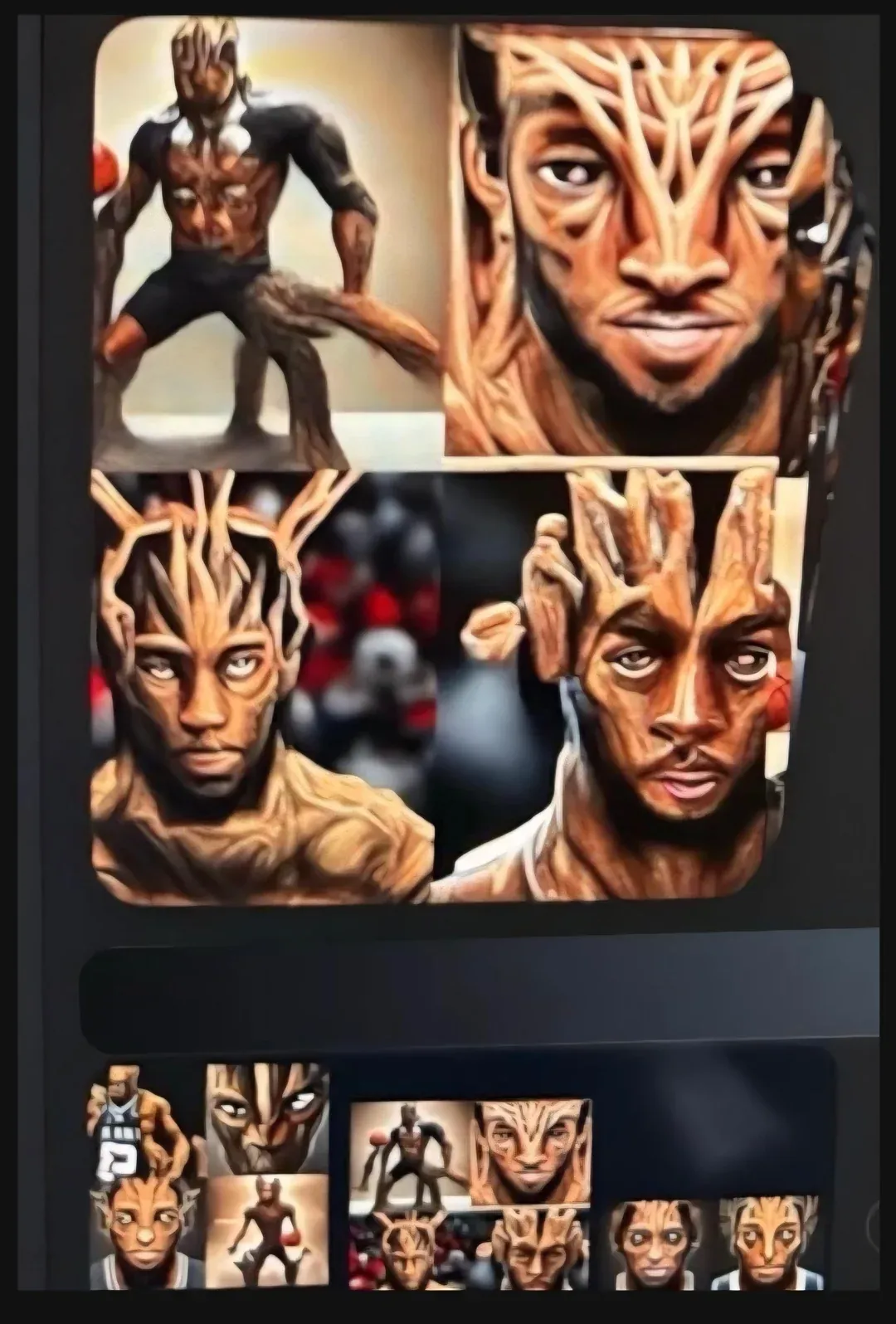
Holy smokes. I think we solved our problem of how Kawhi will be represented in the Basketball Hall of Fame: not as a Spur, Raptor or Clipper, but as Kawroot. Meanwhile, Silver did not announce sanctions regarding the Aspiration scandal on Tuesday, but did blame the Raptors implicitly for their botched trade of Leonard and said the investigation needs to wrap up this summer.
Tyler Herro, oh shoot I mean "sources with knowledge of the encounter," tell Ramona Shelburne of ESPN that Herro was held back from retaliating against Bam Adebayo after the latter struck him in the facial region last week. This is all in a story centered on Herro's comments about needing to move on from the incident.
Herro responded verbally in a way that Adebayo took exception to and the encounter became physical. Sources with knowledge of the encounter told ESPN that Adebayo struck Herro near his chin, although descriptions of the nature of the physical contact is in some dispute.
Herro did not get knocked to the ground, according to sources with knowledge of the interaction, who added that he was restrained by others in the gym from responding physically.
Speaking of which, here's Katie Heindl on the weirdness of the news of this altercation.
Spencer Hall turned 50 and wrote a list of things he's learned, and damn it's perfect. He is a blessing unto the world.
That's Free Newsletter Wednesday. Dearest subscribers: see you Thursday. Dearest non-subscribers: see you next Wednesday. Unless, of course, hint hint ...
Be excellent to each other.