Tanking tomfoolery has hit the tipping point
Anti-competitive tactics threaten to overshadow the whole damn league. It's time for continuous action to stamp out the nonsense.
Anti-competitive tactics threaten to overshadow the whole damn league. It's time for continuous action to stamp out the nonsense.
Good morning. This is another installment of Ziller's sonata cycle on tanking (Op. 3, No. 34). Let's basketball.
Three of the worst teams in the NBA took an extraordinary step at the trade deadline: they traded for good veteran players. The Jazz sent out draft equity for one-time Defensive Player of the Year Jaren Jackson Jr. The Pacers sent out draft equity for highly coveted center Ivica Zubac. The Wizards bought low on five-time All-NBA big man Anthony Davis.
And yet the loudest conversation since those moves has centered around tanking.
Why? Well, Zubac hasn't played yet and there are reports Davis won't play at all this season. Jackson has been benched (alongside star teammate Lauri Markkanen) in both fourth quarters since debuting for Utah despite the Jazz being in competitive games. The Pacers have not participated in tactical tanking this season; the Wizards opened new frontiers with their trades for injured Trae Young and now AD, and the Jazz are making a habit out of benching their best players late in close games. But it's not just them: the Grizzlies and Kings have engaged in tactical malfeasance of late, and the Nets and now Mavericks are clearly engaged in institutional tanking for the rest of the season. (We might add the Bulls to that list at some point. It remains to be seen what exactly they are doing other than resetting the roster. The Bucks could decide to aim for the bottom soon enough, too.)
The scale and breadth of tanking going on right now and expected through April is perhaps unparalleled in the past decade. There are shenanigans and tanking teams every season. But it's never this widespread. More than a fifth of the league is currently trying to lose games, and we could get close to a third of the league within weeks. The NBA thought it "fixed" the tanking problem with lottery reform in 2019. But teams innovate. The league changes. And tanking is as bad as ever.
Because every fix the NBA makes gets explored and exploited, it's imperative that the NBA act more nimbly to manage the incentives and risks of their draft system. You can't just do a major reform every decade or two and hope for the best. The league has to monitor anti-competitive behavior from teams closely and correct the issue, either through direct intervention or structural change.
As I wrote in December, meaningful penalties remain an unexplored path to changing behavior. Currently, the NBA fines teams for anti-competitive rascality. Fines mean little to today's billionaire owner class. A few hundred thousand dollars here or there to improve your odds at landing a salary-controlled superstar is merely a business cost. The fines don't work. (Even when teams change their behavior after a fine, that can be chalked up to shame, which still exists in pockets of the modern world.) I argued in December that an independent panel appointed by the NBA should dock teams lottery combinations for tactical tanking hijinks committed during the season. Furthermore, if those confiscated combinations end up being winning picks in the lottery, they should be announced as such. "The Grizzlies would have won the No. 1 selection; however, that combination was voided when Memphis let Cam Spencer airball an 18-foot fall-away off of an offensive rebound down two as time expired despite the Grizzlies holding a timeout. The next combination chosen belongs to the Pacers, who will receive the No. 1 pick. The Grizzlies ended up picking No. 8."
However, this "fix" is more focused on the symptoms than the cause. The root cause of tanking (institutional and tactical) is the importance of the NBA draft, and by extension the structure of the NBA draft lottery. Most suggested fixes work to address the latter. But there's one adjustment to league rules that could start to help address the bigger issue, and that's the elimination of restricted free agency.
Think about it this way. There are three ways teams acquire the rights to players: the draft, the trade market and free agency. You can imagine a league in which the three paths are in equilibrium.
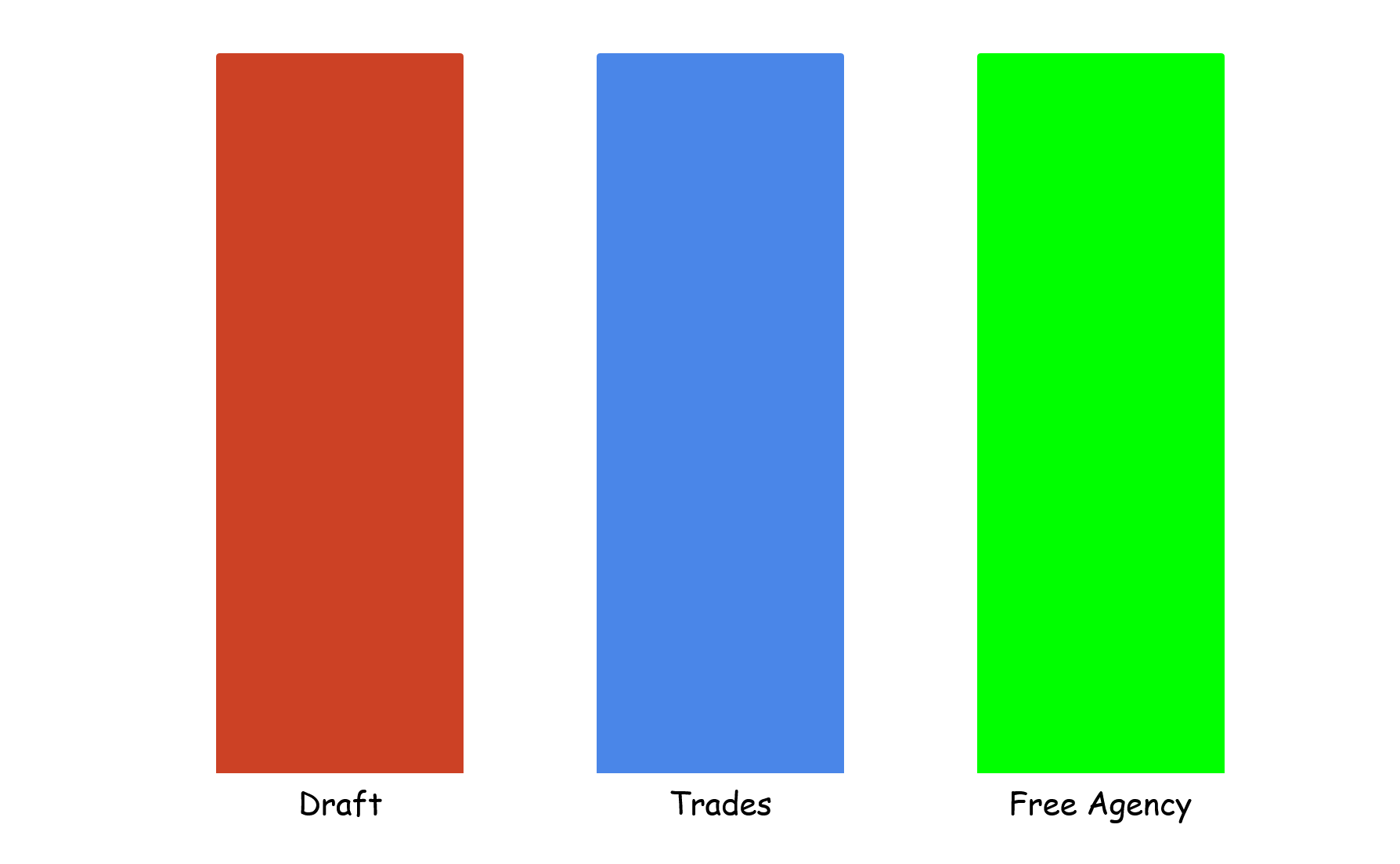
Varied strategies are viable in such a league. Franchises in different situations can focus on the different elements – you can imagine low-glamour markets investing more heavily in the draft and trades and high-resource markets leaning into free agency. But all paths are broadly viable.
This isn't the league we have. The current paradigm in the Apron Era is more like this.
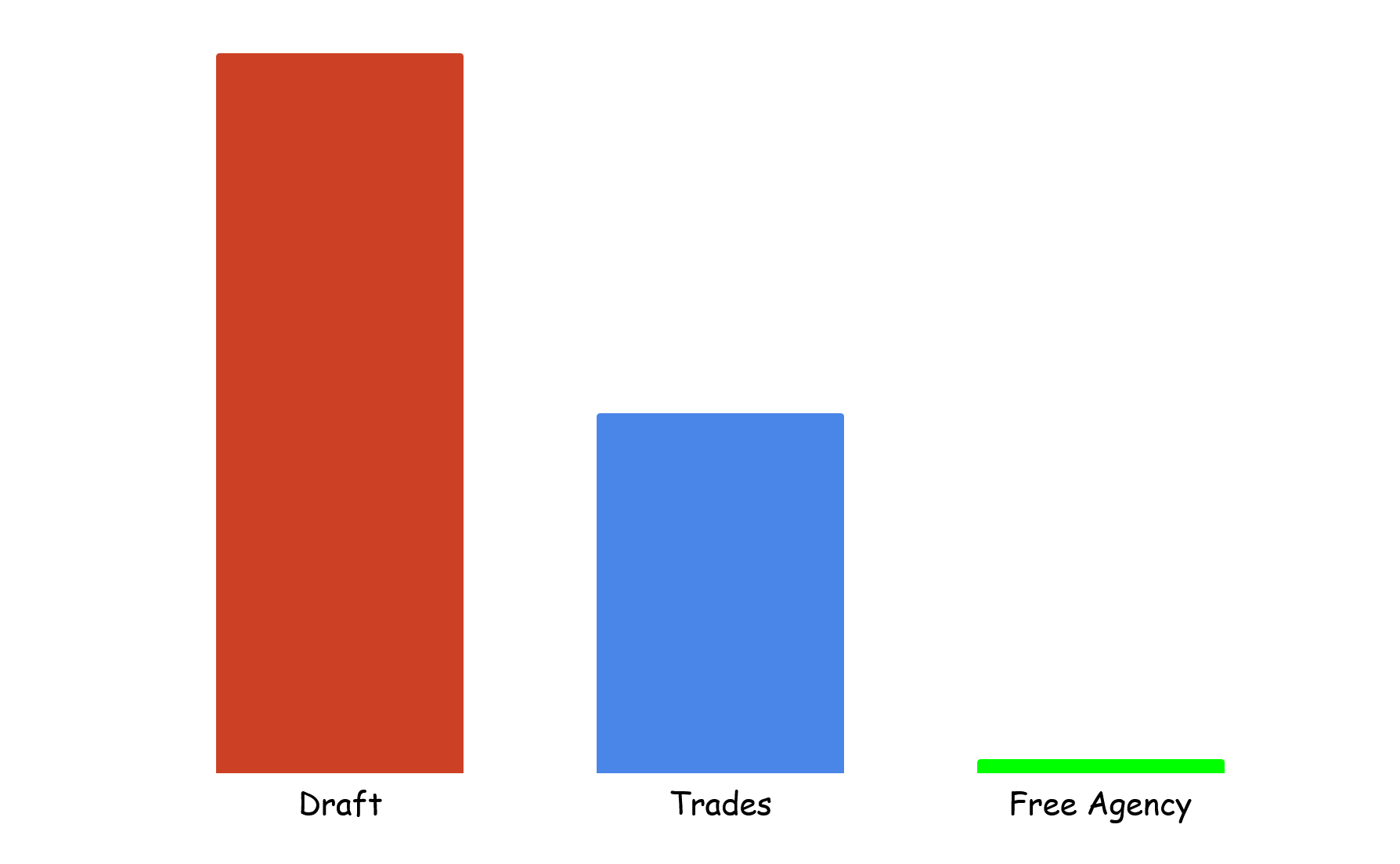
Look at the top four teams in each conference right now. Only one (the Knicks) have a top-2 where neither player was drafted by that franchise. The Knicks, Pacers and Clippers are the only recent high-end teams not built substantially by the draft. All those teams traded draft-heavy packages to land at least one of their stars. And of the teams that did rely on the draft, of course, not all of those drafted stars were high draft picks. The Nuggets are a perfect example there. But they were drafted players, and when a drafted player hits, there's a significant advantage to the team that does so, which reinforces the importance of the draft.
You want to cool off tanking broadly? You need to bring the talent acquisition paths into better balance. Eliminating restricted free agency is a way to both decrease the importance of the draft and increase the viability of free agency. How?
Right now, first-round picks sign rookie contracts that put their career in the control of the drafting team for four years. As Jonathan Kuminga and others learned last summer, that's not quite the end of it: after four years of service, provided the team remains interested, the player enters restricted free agency, which allows incumbent teams to match offer sheets from other teams signed by the player. In the Apron Era, few teams have meaningful cap space to throw at restricted free agents. It's a terrible situation for the RFAs, which means most agents guide their players away from restricted free agent by signing extensions with the incumbent team. In effect, this gives drafting teams not four years of control over a player, but six or seven.
By simply eliminating restricted free agency, teams would only truly have four years of control. After Year 4, if they didn't sign an early extension the prior summer, players coming off of their rookie-scale contracts would be free to sign with anyone with the team that drafted them due no compensation and with no say. This would lead to more teams prioritizing cap space so that they could chase 23- and 24-year-old rising stars and decrease the value of nailing a draft pick since control is chopped from the normal seven years to just four years.
Most stars on rookie-scale deals would probably still sign early extensions after Year 3, so players like Victor Wembanyama, Stephon Castle, Kon Knueppel and Cooper Flagg wouldn't make it to free agency until Year 7 anyways (if ever; liberalized extension rules have done more to hurt free agency than anything). But you'd infuse free agency with some new options, give star youngsters in bad situations an early out, ding the draft and remove one of the most messy contractual issues that continues to crop up.
There's one more concept that should be considered to address the symptoms. The league is reportedly considering putting some rules around pick protections, possibly allowing them to be only protected top-4 or top-14. This would avoid what the Jazz and Wizards are facing, which is that they owe their picks if they fall below No. 8 overall. Based on the current lottery odds, it'd really behoove both teams to be no better than the sixth-worst team in the league. The sixth-worst team has a 4% chance of picking No. 9 or later (thus in the Jazz/Wizards scenarios, losing their pick) while the seventh-worst team has a 14% chance and the eighth-worst team has a 40% chance. The stakes are artificially high due to those pick protections. The argument for restricting pick protections is that you limit the high-stakes threshold to a spot where teams really don't control their own destiny: even the worst team in the NBA only has a 52% chance of picking in the top four.
It's a good idea. Here's a better one: spread the uncertainty by having fate decide the order for the entire lottery, not just the top four picks.
In the Jazz/Wizards example, the reason the odds for a top-8 pick change so sharply between the team with the sixth-worst record and the eighth-worst record is because under the current system, the eighth-worst team cannot pick Nos. 5, 6 or 7. Only the top four picks are up for grabs for everyone in the lottery; then it moves to reserve standings order. The sixth-worst team can't pick No. 5. The seventh-worst team can't pick Nos. 5 or 6. And so on. So with the eighth-worst record, if you need to pick no lower than No. 8 to keep your pick, you have two paths: win a top-4 pick or hope that no team lower than you in the odds leaps into the top four. If you have the seventh-worst record and need to have no worse than No. 8, you can survive one team leaping you. And so on.
But what if you could win the No. 5 pick with the eighth-, ninth- or 10th-worst record? What if the lottery gods set the entire order? I'm not nearly good enough at math to give you a table, and I don't trust my ability to smell-check whatever an AI chatbot would spit out. But you'd remove the cliffs, open the very narrow possibility of the worst team falling to No. 14 while still largely benefitting bad teams, and decrease the salience of the draft in team-building by some degree. It's worth exploring.
All of it's worth exploring, because this is an entertainment product first and foremost, and only the true sickos are going to watch teams try to lose through increasingly creative and disgusting methods. The NBA has to prioritize competition and should spend as much energy as it takes to find solutions big and small.
Like the newsletter? Sign up for more.
Scores
Pacers 137, Knicks 134 (OT) – No Ivica Zubac quite yet, but Indiana still leveled up to visit Madison Square Garden and got the win. The Pacers' bench won this one. Also, the Knicks spotted Indiana a 9-point lead in overtime and almost won anyways.
Clippers 95, Rockets 102 – L.A. went ice cold to start the fourth quarter and Houston took full control. Still leaving a lot to be desired on the offensive end for the Rockets, but the Clippers do have a solid defense-first rotation right now. Good win for H-Town.
I have been blogging/newslettering for Kevin Durant's entire pro career. It really feels like he should have been a Clipper at some point.
Mavericks 111, Suns 120 – Giannis is still not ruled out for All-Star, which means Dillon Brooks has still not been named an All-Star. Frustrating. The Suns are currently in a dead tie for No. 6 with Minnesota, but still sit just two games out of the No. 3 seed. The West seeding situation could get weird.
Spurs 136, Lakers 108 – L.A. sat all their stars with various ailments, so Victor Wembanyama picked up the slack. Twenty-five points in his first eight minutes. Thirty-seven points at the half. The game was, unfortunately, over by then, so he played very little down the stretch. Just a variety of pure destruction. A masterpiece.
Schedule
Twenty-eight teams in action on Wednesday. Holy smokes. All times Eastern.
Hawks at Hornets, 7
Wizards at Cavaliers, 7
Bucks at Magic, 7
Bulls at Celtics, 7:30
Pacers at Nets, 7:30
Knicks at Sixers, 7:30, ESPN
Pistons at Raptors, 7:30
Clippers at Rockets, 8
Blazers at Timberwolves, 8
Heat at Pelicans, 8
Thunder at Suns, 9
Kings at Jazz, 9
Grizzlies at Nuggets, 9
Spurs at Warriors, 10, ESPN
Be excellent to each other.